Pinpointed in the Cultural Triangle Dambulla, holds an esteemed history with the Sri Lankan iconic rock temple, Dambulla cave temple the biggest cave temple complex of Sri Lanka. Dambulla a home to thriving fauna and flora lovers holding the reputation of the largest pink quartz and ironwood forest in Asia. No one misses the spectacular massive Buddha statue the true blessing of the city.
Dambulla situated in Matale 148km from Colombo. The central location Dambulla is a major junction. It converted the city into the vegetable distribution center of Sri Lanka and now Dambulla is called a city of wakeful.
Dambulla Cave Temple
During the English colonial period, Dambulu Viharaya was a center for the nation's freedom. The participation of the Buddhist monks in the Dambulu Vihara was significant in the 1818 Kandyan liberation struggle as well as in the liberation of the country in 1848. Therefore, Dambulla is remarkable throughout history.
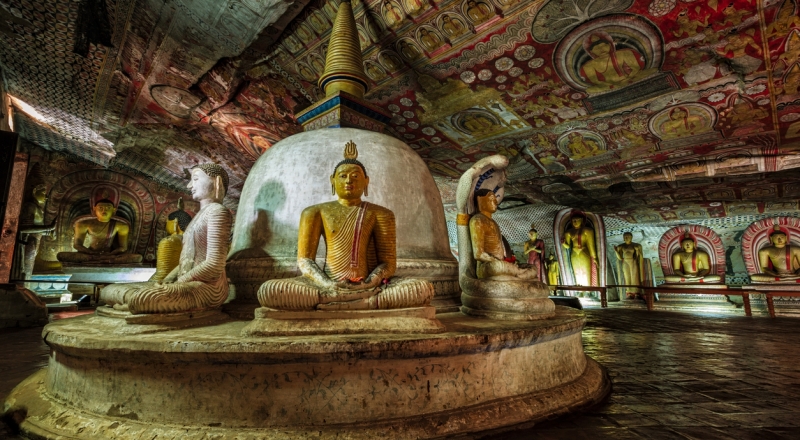
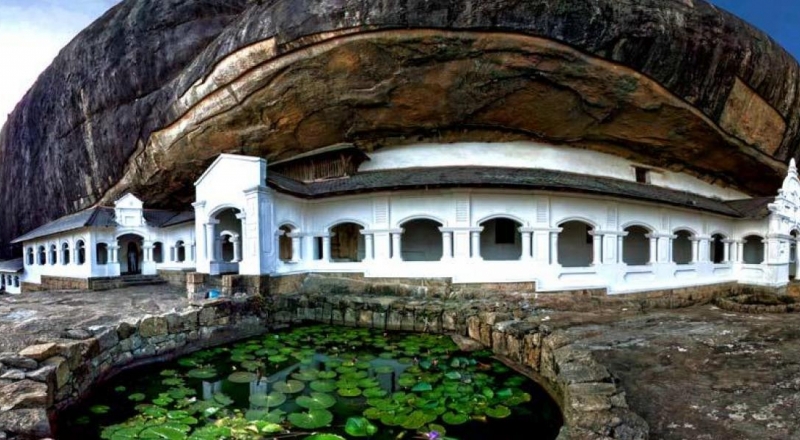
Dambulla is Sri Lanka's largest historic cave temple. It is located 148km North-East of Colombo and 72 km North of Kandy. The murals cover a region of 2,100 m2 of Kandyan tradition. The Dambulla rock is 330m high. It spreads on one side as a rock, and on the other, a mountain of wildlife. The cave temple is built in the area where the stone is spread. On the rock on the plains of Kurunegala, Sigiriya and Ritigala mountains are beautifully visible. The cave temple rock is 65m long and 50 acres in size. On the rock climbing over the cave temple, there are ruins of small stupas and a pond.
2100 years ago, Brahmi inscriptions were found which reveals about Dambulla. Here, 34 such inscriptions have been found beneath the drip. They are referring to the preparation and sacrifice of the caves for the monks. There are five cave temples, and the new Maha Viharaya was built by Keerthi Sri Rajasinghe and the second new temple was built by Dullewe Adikaram in the 18th century. The total number of statues here is 153. Apart from these, three statues are belonging to the kings of King Walagamba, King Nissankamalla, Keerthi Sri Rajasinghe, and 4 images of god Upulvan, goddess Thara, god Natha, and god Vishnu. The paintings were created by the artists of the Nilagama generation
Devaraja the first cave. It is a small cave. There is a colossal statue showing that the Buddha had passed away. A statue of Ananda Thero is found near its feet. It is also home to three seating Buddha statues and a deity Vishnu statue. The inscription of king Nissankamalla is in front. The second cave separates itself from one by a thick clay wall. King Walagamba's and Nissankamalla's figures named the cave as Maharaja Lena. The most significant and winsome paintings, statues nearly 60 are collected. Besides, Deities Natha, Vishnu, Maithre and Upulwan statues are here. Dambulla is the only venue where deity Natha and Deity Maithree statues are at the same spot. Maha Aluth Viharaya, the third cave was built by King Kirti Sri Rajasinghe during the Kandyan Kingdom. Since it was recently done, it has been given the name. A total number of 57 Buddha statues and the most special is seated statue under the dragon pandol. The fourth one is the Pashchima cave. A small one. Dragon pandol beneath Buddha statue and multi-decorated a small stupa are preserved. Last and fifth is called the second new temple. The cave has a reclining Buddha statue with 11 more. Each of these caves and walls is decorated with Kandyan era paintings.
At the foot of the caves, there is an enormous Buddha statue of the Uyanwatta Temple which recently built. A Buddhist museum, wall painting museum of Central Cultural Fund are other places to better look at.
Ibbankatuwa Pre-Historic Burial
The best evidence of the megalithic era in Sri Lanka is found in Ibbankatuwa, a 4km from Dambulla. 16 tombstones are a burial cemetery with 16 cemeteries was found. According to carbon 14, It has been discovered that the settlements were between 770-350 BC. Research by the German National Research Institute of Germany has shown that some of the carbon is 2,700 years old. There is a charnel house outside of the preserved zone.
The individuals who lived in Sri Lanka around then had the innovation to make stoneware and toughen them utilizing heat. The unearthing show bunches of tombs, with every grave, encompassed by four stone chunks secured with another stone piece on top. A portion of these tombs had contained the possessions of the dead individual, for example, dishes and clay pots, beads, and necklace, etc. Clay article portions are left inside and around the tombs similarly had been found amid archeological unearthing.
Same as present women's desire to wear jewelry Megalithic women too have worn jewelry. Necklaces, bangles, beads have found from the tombs. It is clear that at that time Sri Lankans possessed advanced technology at the Megalithic era. Ladies have applied mascaras using 190 millimeter-long rods.
Kandalama Reservoir
Kandalama Reservoir a serene and magnificent man-made lake 4,8km long, 2.3km wide with a catchment area of 102km2 and 33,300,000km3 in volume. Originally made by a Lambhakarna dynasty king and destroyed by invader Kalinga Magha. the Kandelle or Candelay reservoir, as it was additionally known, is situated in the town of Kandalama and was made by damming one of the primary tributaries of Kala Wewa. Due to the beautiful surrounding water reservoir and water throughout the year, the Kandalama reservoir is a popular destination.
The venue is on appreciation from very early times as “The Lake of Kandelle, or as it is commonly termed, the Kandelle waters, is, in the opinion of connoisseurs, the most beautiful lake in Ceylon, and, from its being enveloped on all sides by lofty hills, it will bear inspection from several points. This is more than that can be said of many of the lakes, which are generally tame at the lower extremities. But it is the peculiar beauty of the waters of Kandelle, that in their case the ground ascends everywhere from their edge with a nearly equal degree of boldness.” By Charles Pridham in A Historical, Political and Statistical Account of Ceylon and its Dependencies, the year 1849