A Legendary city of ancient Sri Lanka by being a mighty kingdom. Kurunegala is very famous with its Ethagala and surrounded rocks. When ruler Vijaya ousted Kuweni, the Yakkha tribe leader from his palace to marry another woman Kuweni committed a curse with great anger. It has transformed the surrounded animals into rocks. An elephant, a tortoise, a goat, a beetle, and an eel transformed to Ethagala, Ibbagala, Elugala, Kuruminiyagala, and Andagala respectively. The people of Kurunegala believe that there is a lot of historical facts hidden in every rock.
Kurunegala is a prominent city in Sri Lanka which is the capital of North-Western province. It is around 94 km from Colombo and 42 km from Kandy. As the rocks acted a natural defensive bundle and fertility made Kurunegala into a kingdom.
Attractions
Elephant Rock
Kurunegala is encompassed by rocks and the Ethagala or elephant rock is the biggest among. The stone is 325m tall and looks like the monstrous state of an elephant. As indicated by fantasies, the territory around the elephant rock was encountered an extremely dry season which result shortage of water for creatures and those imperiled creatures later turned as extensive rocks. The fantasy was intended to suit the importance of the athugala, the substantial elephant. The route along the stone way is eco-friendly. At the highest point of the stone, there is an 88ft Buddha statue has built. The Kurunegala town is picturesque to see from the top of the stone.
Panduwasnuwara Royal Citadel
Panduwasnuwara is a widespread zone with ruins of monuments are dated back to the 12th century AD. A moat, gigantic fortification divider, and the imperial royal garden remainings are visible today. It has been discovered that the floor plan at the Palace complex found in Polonnaruwa has a closer likeness to that in Panduwasnuwara. Further on are picture houses, block dagobas, and monastic living precinct. Pursue the street, the long run goes to a reestablished tooth sanctuary (Dalada Maligawa) with a bodhi tree, a brightly painted resting Buddha sanctuary and, behind that, the remaining parts of an entrancing round castle (clearly once multi-storeyed) encased in a roundabout moat.
When strolling towards the inside of the Palace, one could see vestiges of numerous rooms crossing directly around the Palace. These had utilized by the regal family while a few rooms were utilized for storing purpose. Where the position of royalty once sat could likewise be seen soon after Nissanka Malla's shake engraving. The first mortar which was utilized to develop the royal residence could at present be seen today.
Strolling towards the Palace inside one could King Nissanka Malla's engravings which depict how he was engaged by the artists while on his way once again from Sri Pada can be seen. Along these lines, the stronghold likewise had a rest house for the eminence amid the Polonnaruwa time frame.
The prediction on royal princess Unmada Chitra's son will kill the uncles and become the heir to the throne afraid her brothers and imprisoned her in a tower. It is situated a few meters away from the premises of Panduwasnuwara Rajamaha Vihara, a circular bulwark amongst trees. It's a story like Rapunzel who Deega Gamini, the lover of Chitra climbed the tower and later on she gave birth to son Pandukabhaya, the first king of Anuradhapura.
Rambodagalla Buddha Statue
Rambodagalla Buddha Statue is the biggest rock-cut Buddha statue in Sri Lanka. This statue is situated in Monaragala Temple. An endeavor to make another life for the Polonnaruwa era and to bring the craftsmanship and state of Buddhism to a huge shake. The carving of this statue is with the grip of Indian craftsman and Sri Lankan companionship.
Ridee Viharaya
Ridee viharaya is a beautifully landscaped scenery that is rich in historical, Buddhist and archeological values, can be identified as one of the most significant monuments. It is said that the temple was built during the reign of the Dutugemunu era, history records have been recorded even more. The Mahavamsa states that when the Ruwanwelisaya was built, silver was obtained for the Amba-punkonakara cave and then the king built the Ridee Vihar and placed a Buddha statue of gold. It is also said that the monks in the Maha Sangha initiated with the arrival of Arahant Mahinda Thero, had reached the venue. The Brahmi script bearing caves state the purity today even. The Samadhi statue, about 10 feet high and The dragon's pandal that appears at the back of the statue is not visible anywhere else.
Arankele
The Arankele Historical Complex is a great historical interest. Arankelle historical land is a monastery which lies 20 km away from Kurunegala town. It has been confirmed that these remains were naturally required by Buddhist monks. However, the written sources of this monastery complex are very limited. That is why it is impossible to say exactly when the era was built. Entering the Arankale forest area, first meet with a quadrangular building. It is clear that the remains of a building which can be supposed to be called a hot water shower hall according to the surviving architectural features. The building is 64 feet long and 42 ½ feet wide. A hot water shower hall (Jantagara) is a rare construction in Sri Lanka. Also, this is considered to be essential in the main monasteries. Archaeologists say that hot water bathing is common, but the steaming is special. There is a well-preserved building called Padhanagara which used for meditation clusters. It has two oblong stages connected by a stone bridge. The site for the ponds in this place has been selected to receive water from the hills. Overall, all of the ponds have been built in the lowlands. This shows that these are built according to a visionary design. The herbal grinders, medicine strainers, sick rooms are done out of massive rock slabs, urinals and long walkways all it says that the venue is something more than a monastery a well skillful outcome of ancient architecture.
Nikayalannuwara Temple
The Nikayalannuwara temple, a Buddhist learning seat was one of the main sanctuaries who worked to pay tribute to Arahat Mihindu Thera's visit to Sri Lanka. The sanctuary has 3 old stone engravings that give memorable insights about Mihindu Arahat Thera, King Devanampiyatissa and King Mihindu the sixth. Temple has important relics inside its premises.
Panavitiya Ambalama
Ambalama is referring to a resting place for all kinds of people irrespective of race, caste, wealth or age. Kurunegala has Panavitiya Ambalama a spot acclaimed for wood carving. The ambalama has built on four huge stone slabs, with a tallness of feet to avoid harm from termites. Wooden columns bolster the rooftop. Nine internal wooden mainstays of around 6 feet in tallness are impeccably cut. Be that as it may, the 19 external wooden columns are not cut so well. Carvings like Gajasinghe Katayama, Hansa Puttuwa, dancing models and flower decorations are visible. Numerous wood carvings that could be seen in Embekka Devalaya could likewise be seen here.
Yapahuwa
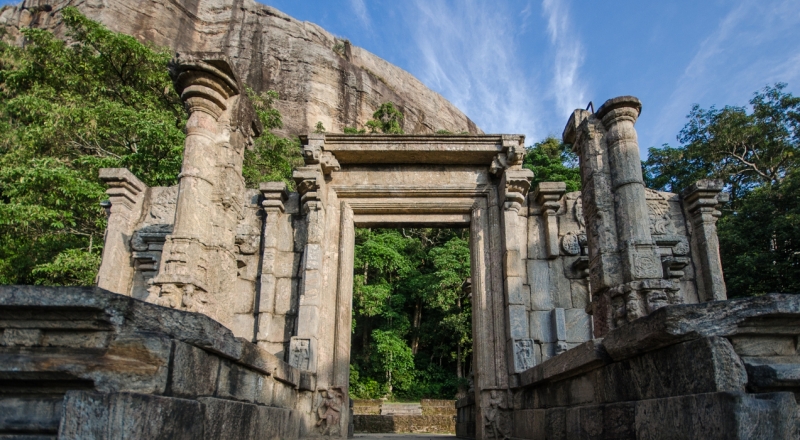
Yapahuwa was a capital and the royal resident Sri Lanka in the 13th century shifted from Dambadeniya which is 112km from Colombo. The imperial home was lucky enough to gift some fascination remaining which is a colossal stairway that stays as a milestone of the architecture.
Yapahuwa kingdom was associated with Yapahuwa mountain which was a Buddhist monastery, as said by mountain top cave wall inscription. The kingdom is an outer and inner city that had separated by a rampart and moats of mud and water.
Haththikuchchi Temple
The premises, an elephant head figure marked which has given the name Harchikuchchi. The 300 acres extend this temple has its own architectural structures of the chapter house, the temple of relics, a circular structure of watadageya, 38 caves plus pond. The remaining believed to have belonged to the 2nd and 9th century BC as in accordance to rock inscriptions. The historical Mahavamsa says King Sirisangabo is said to have given away his head by his own here in order to save the kingdom.
Nillakgama Bodhighara
Bodhighara, the protective building around the bo-tree. Nilakagama is known for the best stone bodhighara construction engraving elephants and flower petals along the border. Anuradhapura or Polonnaru eras belong construction remark the specialty by being the one and only left of the kind in Sri Lanka.
Dolukanda Herbal Forest
Dolukanda is an herbal forest recognized with a specified and diversified environmental context about 700ft above sea level. It is considered to be a part of the Himalayan mountain brought by Hanuman to treat prince Lakshman when he injured at war. It has rare varieties of medical herbs. Passing Ganewatte, 18km off Kurunegala this 4.5 miles long mountain chains is reachable.
Resvehera
Resvehera is a proud 2100 years back temple by King Walagamba. The way from Kurunegala and turning at Yapahuwa road Resvehera alias Sasseruwa is reachable.
Two cavern temples replete of standing Buddha statue with 42’ 4’’ tall and a reclining Buddha statue with original cloth robe covered still visible at certain places. Resvehera owns the only Buddha statue of a rock temple which possible walk around to veneration. Chronicles reveal 99 stone caves sheltered 365 Arahat (Enlightened) Bhikkus.
The Bo tree of Resvehera, an originated direct sapling from Anuradhapura sacred Sri Maha Bodhi. As it says when sapling was planted, the halo of Lord Buddha illuminated the around.